
 Just returned from Mesa Verde National Park. Spent one hour on a guided tour of Balcony House, so we now know everything about the Anasazi (recently renamed A.P. - "Ancient Pueblos") tribe.
They lived in masonry-finished cliff dwellings for 100 years or so. Things were relatively stable for the A.P. They spent the growing season tending squash, corn, and beans, but were bored during the dull winter months they lived in their kivas.
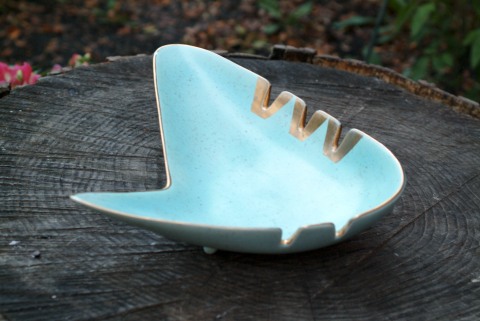 National Park guide Bill mentioned 1 or 3 or maybe 5 times that to pass the time, the men made arrowheads, and the women, pottery. Bill seemed to think that anytime a woman had a moment, she'd dash off to make clay pots, pipes, butter dishes, ashtrays, you name it.
 The arrowheads were always in short supply; too many lost aiming for the beer bottles lined up across the canyon.
The pottery, however, stacked up. From what I can piece together with the museum displays and a bit of my own investigation, the A.P. women were a bit more responsible than their counterparts, and did not break or lose their goods. As a result, rooms intended to store dry goods ended up cluttered floor to ceiling with their crockery.
Now, here's where things get interesting, and a lesson is to be had by all. One of the young A.P. ladies fresh back to the cliff dwelling after finishing her MBA at Utah State, had a fateful idea, "Why don't we sell these on the side of U.S. Hwy 160 to passersby".
Soon, the A.P doubled down on their pottery work. They extended their working months througout the growing season, signed a 10-year lease on a recently vacated chotsky shop, branded it the "Anasazi Papparazi", and waited for customers.
Unfortunately, they waited for a long while, as U.S. 160 had not yet been constructed . The A.P. soon realized that they were the only people for hundreds of miles around (seeing at though their descendants, the Pueblo, Hopi, Zuni, etc. had not yet been born).
The A.P.'s over-investment in hand-made pottery did not match market demand, and the cliff dwellings were foreclosed upon, in what became the Great Pottery Bubble of 1272. A classic case of an idea before its time.